
Knowledgebase
Silver Maple Tree #458187
Asked May 30, 2018, 4:52 PM EDT
Genesee County Michigan
Expert Response
Don't be alarmed as the spots on your leaves are a result of Tar Spot. I am including information that will explain the condition in ore detail. Thank you for using Ask an Expert.
Homeowners with maple trees are calling the Michigan State University Extension Lawn and Garden Hotline concerned about numerous spots appearing on the leaves.. The disease is caused by several fungi in the genus Rhytisma and infects silver, sugar, red and Norway maple as well as their relative, box elder.
Symptoms
Tar spot is one of the most readily visible and easiest maple diseases to diagnose. It’s also one of the least damaging ailments on its host. The first tar spot symptoms usually show up in early summer as small (less than 1/8 inch diameter), light-green to yellowish-green spots. The spots enlarge and color intensifies as summer progresses. Small, black, tar-like raised structures form on the upper surface within these yellow spots. The black spots continue to grow in diameter and thickness to the point where it looks like someone splashed tar on the leaves. (This is the time when homeowners become rather alarmed.) Symptoms tend to be more common on trees growing in moist, sheltered locations.
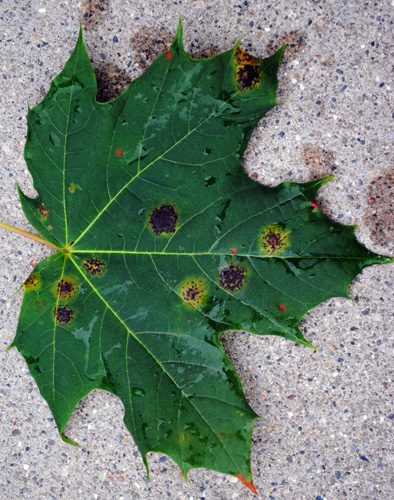
Early symptoms on Norway maple. Photo credit: Mary A. Wilson, MSUE.
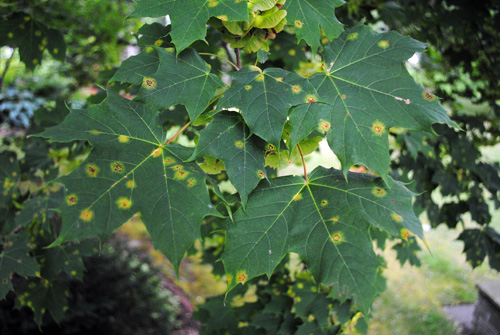
Current symptoms on Norway maple. Photo credit: Mary A. Wilson, MSUE.
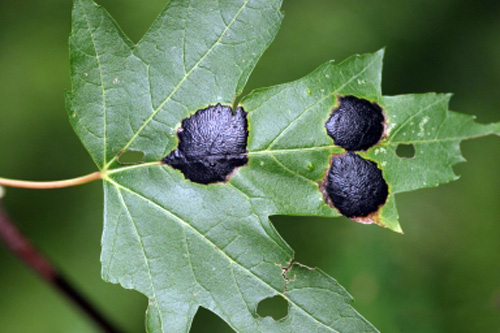
Silver maple leaf infected with tar spot. Photo credit: Steven Katovich, Bugwood.org.
Impact
This disease is usually a cosmetic problem and does not affect the long-term health of the tree. Heavy infections can cause premature leaf drop – a circumstance that causes great consternation to homeowners because lawns are littered and must be raked before autumn typically arrives.
Management
Since tar spot fungi overwinter in fallen leaves, the most effective management technique is to rake and destroy leaves in the fall. This will reduce the number of overwintering “spots” (containing the fungal reproductive structures) that can infect new leaves the following spring. Neighbors should also rake and destroy infected leaves to be effective. Mulching leaves will destroy many of the spots before they mature, but the mulch pile should be covered or turned before new leaves begin to emerge in the spring.
Applications of fungicides are possible when high levels of infection become unacceptable, but control of tar spot is challenging, especially on mature maples. In addition, if others in a neighborhood setting are not managing the disease on their trees with fungicides or proper sanitation, the act of spraying may be a waste of time and money.
More information on tar spot disease can be found in the MSU Diagnostic Clinic Maple Tar Spot factsheet.
For additional gardening information, call theMSU Extension Lawn and Garden Hotline at 1-888-MSUE-4MI (<personal data hidden>). You can also visit www.migarden.msu.edu.

